TM 5-3805-260-24
Current Recommendation
Use nitrogen (N2) gas for all pneumatic
tires. Nitrogen not burn inside the tire.
WARNING
Correct nitrogen inflation (charging) equipment and
training in its use are needed to prevent too much
pressure in a tire. A tire blowout or rim failure can
result from equipment that is not correct or is not
correctly used.
Also, the use of nitrogen instead of air in the
tires, decreases the amount of tire deterioration. This is
especially important for tires that ha-e an expected long
service life (4 or more years). It also decreases the
corrosion
of
rim
components,
which
decreases
disassembly problems.
The pressure of a full) charged nitrogen cylinder
is approximatelI5 15000 kPa (2200 psi). This high
pressure can cause a tire blovwout and or rim failure if
the charging equipment is not used correctly. See Tire
Inflation (Charging) With Nitrogen.
Tire Inflation (Charging) With Nitrogen
WARNING
Servicing and changing tires and rims can be
dangerous. This work must be done only by trained
personnel with correct tools and procedures. If
correct procedures are not followed while servicing
tires and rims, the assemblies can burst with
explosive force and cause serious physical injury or
death. Follow carefully the specific information
provided by your tire servicing man or dealer.
When tires are changed be sure to clean all rim
parts. If necessary, paint the components to present
corrosion. Sand blasting is recommended for removal of
rust. Check all components carefully and replace any
cracked,bad) worn, damaged, severely rusted or
corroded
parts
with
new
parts
of the same size and type. If there is any doubt,
replace with new parts. Never rework, weld, heat or
braze any) rim components.
The tires on these machines are inflated
(charged)
with
nitrogen
instead
of
air.
The
recommendation is that nitrogen be used for pressure
adjustments in a tire. See your tire dealer for the correct
tire pressures for job conditions and for an) questions
on nitrogen inflation.
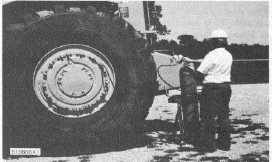
CORRECT POSITION FOR TIRE INFLATION
(Behind the Tread)
WARNING
A tire blowout or rim failure can occur during tire inflation.
To prevent possible injury get next to (behind) the tread,
as shown, when inflating a tire.
Set the regulator of the nitrogen inflation equipment at no
more than 140 kPa (20 psi) over the correct tire
pressure.
CAUTION
Use only the 6V4040 Nitrogen Tire Inflation Group
to inflate tires from a nitrogen gas cylinder. See
Special Instruction, Form Number SMHS7867 for
tire inflation instructions.
Use the same tire pressures for nitrogen inflation
that are used for air inflation. See the Operator’s
Manual for the shipping and operating pressures.
2-156